
Interlock Laying & Paving in Dubai & Sharjah
Driveways, car parks, walkways and landscape paving, built on a compacted sub-base with correct falls, so the surface stays level. New laying, lifting and relaying, and restoration.
In this climate /
Sunken interlock is a sub-base failure, not a paving failure Interlock that has dipped, rutted or gone wavy almost never failed because of the blocks. It failed because of what was under them.
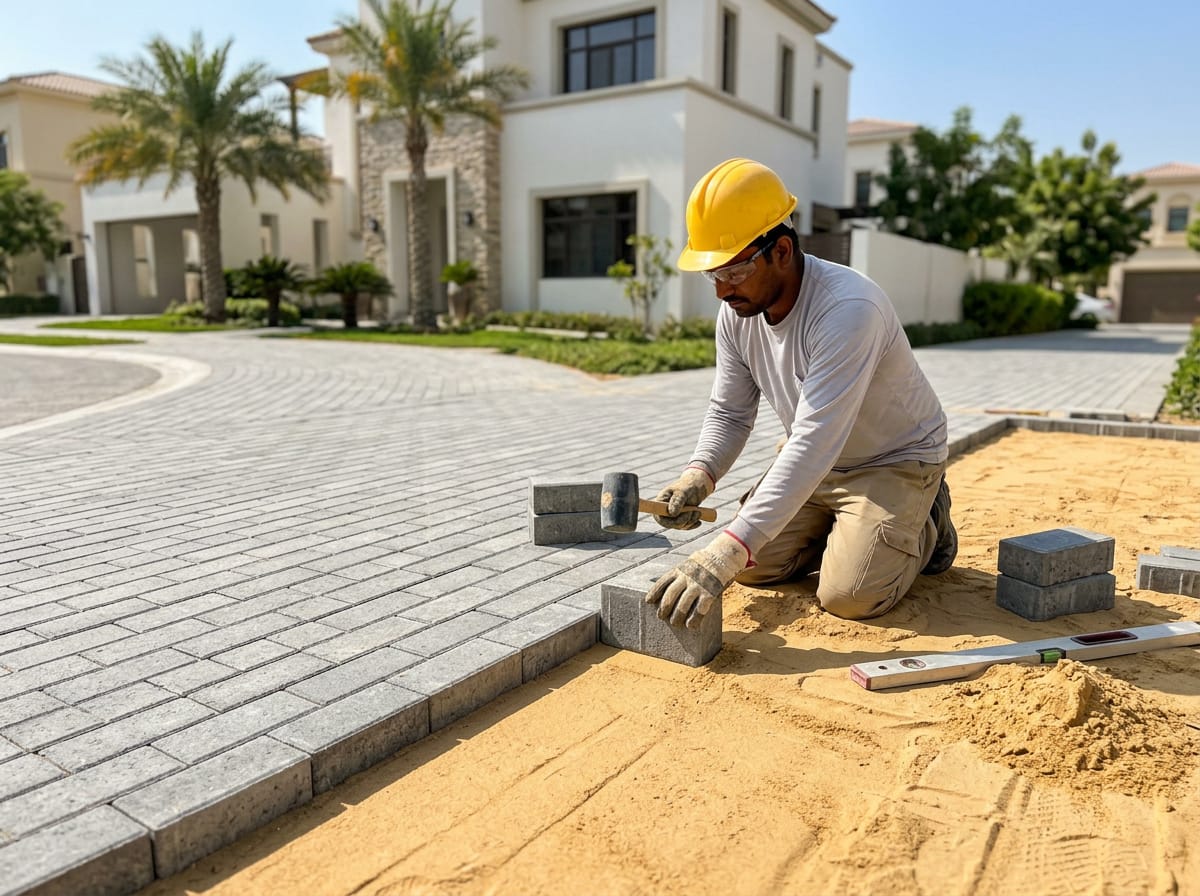
The sequence that produces a lasting surface is unglamorous and largely invisible once finished: excavate to the correct depth, lay and compact a granular sub-base in layers rather than all at once, screed a consistent bedding sand layer, lay the blocks, install proper edge restraint, then compact and sand the joints. Skip the layered compaction, and the sub-base consolidates unevenly under load over the following months. Skip the edge restraint, and the whole field slowly spreads sideways, which is why so many Dubai driveways have widening joints at the perimeter.
Two local factors make this worse than it would be elsewhere. Fine desert sand migrates into and out of joints continuously, so joint sand needs replenishing and, on driveways, stabilising. And when it does rain here, it arrives fast and in volume, so falls and drainage matter far more than the annual rainfall figure suggests. Paving laid flat, or falling towards the building, causes water ingress at the wall base, a problem we are frequently called to fix long after the paving contractor has gone.
We spend most of the programme below ground level. That is what determines whether it is still flat in five years.
Scope /
What we do
Installation
- Interlock paving supply and laying
- Driveway construction
- Car park paving
- Walkways and pathways
- Pool surrounds and decking areas
- Courtyards and terraces
- Landscape hardscaping
- Kerbstone and edge restraint
- Wheel stops and bollards
- Line marking and bay numbering
Preparation
- Excavation and disposal
- Sub-base supply, laying and layered compaction
- Levelling and grading
- Falls and drainage design
- Drainage channel and gully installation
- Geotextile membrane installation
- Concrete sub-base where loading requires it
Repair and restoration
- Lifting and relaying sunken areas
- Re-levelling
- Individual block replacement and matching
- Joint sand replenishment and stabilisation
- Edge restraint repair
- Pressure washing and cleaning
- Sealing
- Weed treatment
- Oil stain removal
Associated works
- Concrete works and slabs
- Boundary and retaining walls
- Steps and ramps
- Garden edging
- Artificial grass installation
- Drainage connection
Symptoms /
What we get called for most
Interlock that has sunk in patches
Inadequate or uneven sub-base compaction, or a service trench backfilled without proper compaction. We lift the affected area, correct the base and relay, patching the surface alone means it sinks again.
Wavy or rutted driveways
The base was not built for vehicle loading. Driveways need a deeper, properly compacted sub-base than footpaths; the same specification used for both is a common shortcut.
Joints opening up and blocks moving
Failed or missing edge restraint. Without a kerb or restraint holding the perimeter, the field spreads under load.
Water pooling on the surface, or running towards the house
Falls were never set, or were set incorrectly. This is worth fixing properly, water at the base of a wall causes damp and structural problems far more expensive than repaving.
Sand washing out of joints
Normal to a degree, and easily corrected with replenishment. On driveways, a stabilising sand or joint sealant slows it considerably.
Faded, stained or weed-grown paving
Usually restorable. Pressure washing, re-sanding and sealing generally brings paving back rather than replacing it, at a fraction of the cost.
A new villa where the developer's landscaping is minimal
Driveway, walkways and courtyard laid to a proper specification from the start.
Car parks needing resurfacing and remarking
Often at night or in phases so the facility keeps operating.
How we work /
- 01
Survey
Existing levels, drainage points, expected loading, and what is under the surface.
- 02
Design
Falls, drainage, layout, block type and pattern. We confirm where water will go before laying anything.
- 03
Excavation and sub-base
To the depth the loading requires, compacted in layers, tested as we go.
- 04
Bedding and laying
Consistent screeded bed, blocks laid to pattern, cuts made cleanly at edges.
- 05
Restraint and finishing
Edge restraint installed, joints sanded, whole area compacted, final sand pass and clean.
Indicative pricing /
What this work typically costs
- Interlock supply and lay, pedestrian
- On survey
- Interlock supply and lay, driveway/vehicle
- On survey
- Lifting and relaying existing
- On survey
- Sub-base preparation
- On survey
- Kerbstone installation (per linear m)
- On survey
- Pressure washing and re-sanding
- On survey
- Sealing
- On survey
- Car park line marking (per bay)
- On survey
Priced on survey. Free site survey and fixed written quotation before work starts.
Why Spanex /
Why Spanex for interlock and paving
We build the base properly
Layered compaction to the correct depth for the loading. It is the invisible part, and it is the whole job.
Falls set deliberately
Water is directed away from buildings and to drainage. Getting this wrong causes damp problems that cost far more than the paving.
Edge restraint always
Without it, paving spreads. It is not an optional extra.
Restoration before replacement
Much of the tired paving we look at can be lifted, relaid and re-sanded rather than replaced. We will quote the cheaper route where it is the right one.
Sectors we serve /
- Premium villas
- Residential buildings and communities
- Retail and malls
- Schools
- Industrial facilities
- Sports venues
- Commercial properties
Questions /
Frequently asked
Why has my interlock sunk?
Almost always inadequate sub-base preparation, insufficient depth, or compaction done in one pass rather than in layers. Sometimes a service trench was backfilled without proper compaction. The fix is to lift, correct the base and relay.
Can sunken areas be repaired without redoing everything?
Yes, where the rest is sound. We lift the affected area, rebuild and recompact the base, and relay using the existing blocks so it matches.
Do I need drainage in my paving?
You need falls at minimum, so water runs away from the building. Where there is nowhere for it to go, or the area is enclosed, you need drainage channels. We design this at survey, it is the detail most often skipped.
Why does sand keep washing out of the joints?
Normal to an extent, particularly after rain or pressure washing. Regular replenishment fixes it. On driveways, stabilising sand or a joint sealant substantially reduces it.
Can old interlock be cleaned rather than replaced?
Usually, yes. Pressure washing, re-sanding and sealing restores most paving. Replacement is only needed where blocks are broken or badly spalled.
Do you lay interlock over concrete?
Yes, provided the concrete is sound and drainage is addressed. It is common for terraces and roof decks and needs a different bedding approach from ground-level laying.
Can you do car parks at night?
Yes. Commercial car parks are usually done in phases or overnight so the facility keeps operating.
Next step /
Get a fixed price for your interlock laying & hardscaping
Free survey anywhere in Dubai and Sharjah. Written scope and fixed quotation before work starts.